
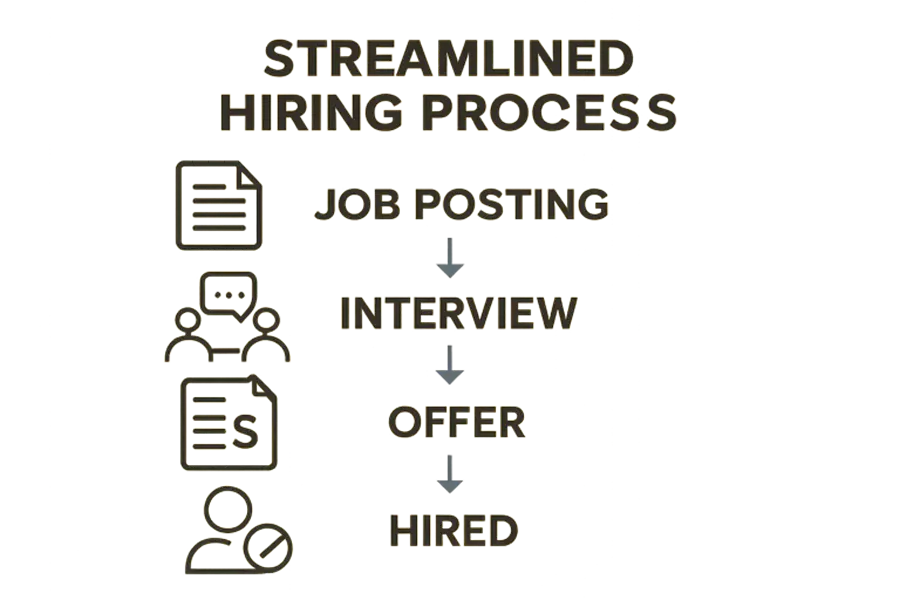
In today’s ever-evolving and highly competitive job market, organizations must seek every opportunity to refine their hiring processes for better financial outcomes. Streamlined hiring efficiency paves the way toward significant gains—not just in terms of cost savings, but also fulfilling hiring goals faster, boosting productivity, and securing top-tier talent before competitors do. Companies that focus on impactful recruitment not only enhance their bottom line but also build a stronger foundation for long-term growth.
Traditional, time-consuming recruitment funnels are no longer sustainable, as top candidates can be off the market in days. Optimizing for efficiency reduces bottlenecks and drop-offs while maintaining a thorough and unbiased process, creating a seamless experience for recruiters, candidates, and hiring managers.
Improving recruitment efficiency isn’t just cost-saving—it drives tangible organizational value. Using digital tools, structured assessments, and a skills-based approach, hiring can become a driver of ROI. Forward-thinking organizations see higher retention, faster time-to-productivity, and a stronger employer brand.
Understanding Recruitment ROI
Recruitment ROI is the calculation of hiring value versus the financial and resource investment required. Important metrics include time-to-fill open roles, cost-per-hire, productivity ramp-up time, and employee retention rates. The higher these numbers trend positively, the more hiring contributes as a profit center within the business. Cultivating a high recruitment ROI means that every dollar spent and every hour invested fuels genuine business impact—not just headcount, but also performance and longevity.
Streamlining the Hiring Process
Long, fragmented recruitment cycles not only risk losing skilled candidates but also inflate costs, burden HR teams, and diminish employer brand appeal. Efficiency starts with simplification—eliminate redundant paperwork, automate recurring tasks, and ensure all decision-makers are aligned from the start. Integrating applicant tracking systems (ATS) with customer relationship management (CRM) platforms enables recruiters to collaborate seamlessly, focus on qualified applicants, and accelerate the overall speed-to-hire process.
These connections also strengthen long-term client relationships when working in agency settings, contributing to stronger client retention and repeat placements. In-house talent teams that utilize integrated tools can provide hiring managers with real-time updates, helping decrease decision-making delays and fostering greater trust throughout the organization.
Leveraging Technology in Recruitment
Modern hiring leverages a digital-first approach, using AI and machine learning to identify talent, automate resume filtering, and even predict candidate success. AI-driven platforms rapidly screen resumes, reducing recruiter workloads while uncovering hidden gems that might be overlooked in manual reviews. Companies that adopt advanced recruitment technology have seen a 50% increase in candidate response and a 30% reduction in fill time.
Technology’s role extends beyond matching candidates; it can personalize candidate communications, schedule interviews, and even gather predictive data on who is most likely to succeed after hire. These innovations lower biases and ensure every applicant receives due consideration—supporting diversity and enhancing talent quality.
Adopting Skills-Based Hiring
By focusing evaluations on competencies rather than just educational credentials or past job titles, organizations are expanding their talent pipelines and uncovering new sources of talent. Skills-based hiring expands the talent pool, enabling organizations to match candidates to roles based on their current capabilities, rather than just their experience and background. Research from LinkedIn shows that prioritizing skills over traditional qualifications can significantly increase the talent pool, particularly in fields where certain groups have been underrepresented. For instance, skills-based hiring could boost the talent pool of women by 9% in such fields.
Hiring for skills shortens onboarding time, improves productivity, and boosts retention—since employees are better matched to the job requirements from the start. This approach levels the playing field for self-taught professionals and career changers, providing greater access and equity within the hiring process.
Implementing Structured Interviews
Consistency is key to objective and predictive interviewing. Structured interviews ensure every candidate is evaluated against the same predefined criteria, reducing hiring bias and enabling clear apples-to-apples comparison. Studies consistently show that structured interviews outperform “gut feeling” approaches, resulting in higher job performance and lower turnover rates.
Organizations that provide interviewer training and clear rubrics report better hiring accuracy and greater confidence in their selection decisions. In addition, structured interviews help communicate company values clearly, aligning candidates’ soft skills and work approaches with the organizational culture.
Enhancing Candidate Experience
A robust candidate experience doesn’t just help fill jobs faster—it’s a critical driver of employer brand and offer-acceptance rates. Organizations that streamline applications, send timely follow-ups, and provide transparent feedback report higher candidate satisfaction and engagement. For example, the inclusion of video-enhanced job posts has increased application-to-interview conversions by 35%, engaging passive talent and busy professionals.
Transparent communication keeps top contenders invested, even when they don’t land the role, minimizing negative reviews and building referral networks for the future.
Measuring and Analyzing Hiring Metrics
Continuous process improvement depends on robust data tracking. By monitoring metrics such as time-to-hire, cost-per-hire, and quality-of-hire, organizations can identify weak points and invest strategically for rapid ROI improvements. Predictive analytics makes hiring more agile: Leaders can respond in real time to what’s working and what’s not.
In fact, organizations utilizing advanced analytics reported hiring outcomes that were 2.5 times better than those of their peers, according to McKinsey. This data-first approach ensures hiring strategies remain tied to business value, not just process tradition.
Conclusion
The most successful hiring teams are not only efficient—they’re adaptive. By investing in the right technology, reevaluating their processes, and focusing on candidate-focused practices, organizations can unlock hidden value from each recruitment cycle. Whether through structured interviews, skills-centric sourcing, or data-powered decision-making, optimizing every step of the hiring process puts companies on the path toward consistent, measurable ROI and a future-proof workforce.
Also Read-How to Sell Your House Fast Without a Realtor

James is a senior editor at axprassion.com with over a decade of experience in crafting compelling narratives and making complex topics accessible. His articles and interviews with industry leaders have earned him recognition as a key influencer by organisations like Onalytica. Under his leadership, publications have been praised by analyst firms such as Forrester for their excellence and performance. Connect with him on