
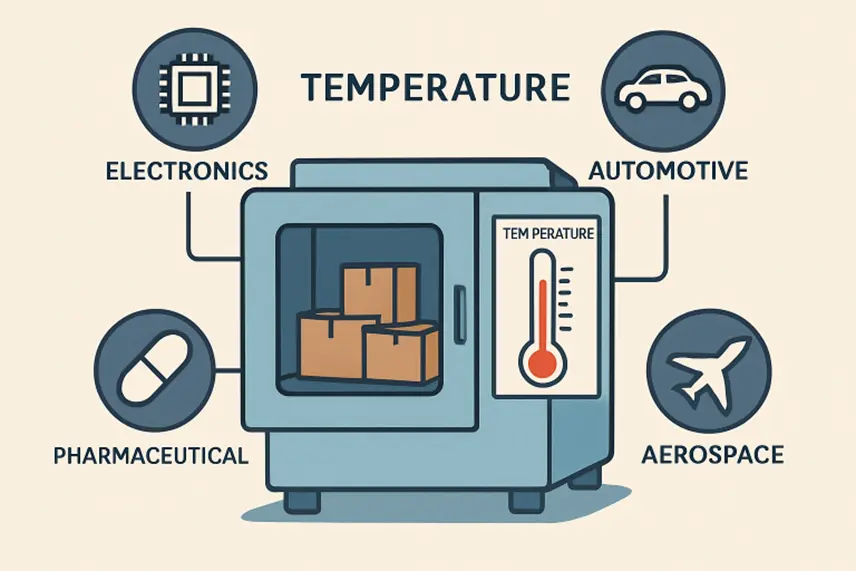
As technological innovation accelerates, the demand for robust and dependable products continues to grow. To ensure reliability and longevity, manufacturers use temperature chambers to simulate various environmental scenarios and verify how their products perform under different conditions. These controlled environments are critical for quality assurance, and a chamber temperature solution must offer both accuracy and repeatability for effective testing.
By exposing products to cycles of hot, cold, or humid conditions, engineers and designers can identify vulnerabilities long before their products reach consumers. Temperature chambers are foundational across a wide range of industries, enabling the proactive identification of failures and compliance with stringent standards. The significant role they play is only increasing with the rise of complex electronics, electric vehicles, and precision pharmaceuticals.
Testing in temperature chambers isn’t reserved for the latest gadgets or high-end industrial components. Everyday products, from medical devices to transportation parts, must all prove their quality in varying climate conditions. The stakes are high, especially when a single weak link could compromise user safety, trust, or a company’s reputation.
The value of temperature chamber technology is increasing in an era when regulations are intensifying, and consumer expectations are high. Testing in realistic environmental simulations ensures compliance, product safety, and helps set industry benchmarks.
Temperature Chamber Testing in the Electronics Industry
The explosion of digital devices has amplified the necessity for rigorous climate testing. In the electronics industry, temperature chambers are indispensable tools for evaluating smartphones, tablets, sensors, and circuit boards. Subjecting these components to rapid temperature changes and sustained extremes ensures they operate reliably whether in tropical climates or icy regions. Identifying shortcomings in memory chips, batteries, or connectors before market launch helps prevent costly recalls and user dissatisfaction.
Engineers use chamber testing to detect thermal-induced faults such as solder cracking, component drift, or sensitivity loss. By artificially aging electronics within controlled chambers, companies can reveal latent defects that may manifest months or years later. This proactive approach saves considerable resources and safeguards reputations—essential in a world increasingly dependent on electronics for critical infrastructure.
Automotive and Aerospace Testing
Automotive and aerospace sectors rely heavily on temperature chambers to test critical components for durability and safety. Batteries for electric vehicles, for example, must undergo extensive cycling in subzero and high-heat scenarios to ensure safe performance, even during extreme weather events. Sensors, control systems, and structural materials are pushed to their limits to certify that, regardless of the external climate, systems remain dependable and drivers or passengers stay safe.
Ensuring Safety at Any Altitude or Climate
Aerospace parts, such as avionics, wings, and propulsion systems, are subjected to a range of thermal cycles to simulate the conditions encountered at high altitudes and during rapid altitude changes. Certification in temperature chambers is often a regulatory requirement before plane components or satellite electronics are allowed in service.
Pharmaceutical Industry Utilization
In the pharmaceutical industry, temperature stability is closely linked to efficacy and patient safety. Drug formulations, vaccines, and biologics are tested for prolonged stability in temperature chambers that recreate real-world shipping and storage scenarios. By exposing medicines to various conditions, researchers confirm that active ingredients remain potent and safe throughout their intended shelf life—an essential step for ensuring regulatory compliance and public trust.
Protecting Healthcare Outcomes Worldwide
Pharmaceutical companies must meet stringent global stability testing guidelines established by regulatory bodies such as the FDA and EMA. Detailed temperature and humidity cycling help reveal degradation mechanisms, ensuring that medications perform as expected in hospitals, homes, and throughout the global supply chain.
Advancements in Temperature Chamber Technology
With rapid advances in sensor and control technologies, today’s temperature chambers deliver unprecedented levels of precision. Some modern designs are capable of maintaining temperature variations as tight as ±0.1°C, a necessity for developing highly sensitive medical and automotive products. This enhanced accuracy improves test reliability, increasing confidence in product safety and compliance.
Efficiency gains are also substantial, with newer chambers constructed for optimal insulation, rapid cooling recovery, and reduced energy consumption. Environmental sustainability has become a core advantage—new temperature chambers align with industry efforts to reduce excessive energy use, helping organizations meet both internal and regulatory green targets.
Integration of IoT and Predictive Analytics
The fusion of IoT technology and predictive analytics marks a new era for environmental testing. IoT-enabled chambers allow real-time remote monitoring, rapid incident reporting, and automated data logging. Predictive analytics, powered by machine learning, helps forecast when maintenance is needed, minimizing unplanned downtime and extending equipment lifespan. These features increase the efficiency and longevity of chamber investments.
The ability to optimize test parameters with high precision, coupled with instant alerts and automated quality reports, accelerates R&D cycles and speeds time-to-market for new products.
Challenges and Future Outlook
Despite rapid progress, challenges remain. Testing at extreme temperatures requires a robust design to avoid inaccuracies and ensure repeatability. Technical complexities can complicate workflows and require ongoing training for technicians and engineers. As product ecosystems become increasingly complex, future temperature chambers must feature even higher levels of automation, integration, and self-diagnosis to keep pace.
Investment in R&D, along with collaboration between test equipment manufacturers and test equipment makers, is driving a new generation of chambers that are more flexible, adaptive, and environmentally friendly. As global supply chains and product portfolios diversify, the need for sophisticated testing will only grow. The future of product safety and performance will be defined by how well temperature chamber technology evolves to meet these mounting challenges.
Temperature chambers have proven themselves indispensable to modern product development and regulatory compliance. With their central role in risk management and quality assurance, ongoing innovation in this field ensures the ongoing delivery of safe, effective, and reliable products across every industry.
Also Read-How Technology is Revolutionizing Patient Engagement