
The word “overstimulated” means being affected by too much stimulation — like too many sounds, lights, emotions, or activities happening at once.
When someone is overstimulated, their brain and body feel overwhelmed, making it hard to focus, relax, or stay calm.
Have you ever felt like everything around you — noise, people, screens, music — was just too much?
That heavy, tired, and anxious feeling is called being overstimulated.
In today’s world, with constant notifications, bright lights, and nonstop entertainment, overstimulation has become common.
From kids to adults, almost everyone has experienced it — especially after long hours on social media, at parties, or even in crowded malls.
In this article, you’ll learn:
- The meaning of overstimulated
- The signs and causes of it
- How it feels mentally and physically
- The difference between overstimulation and stress
- Simple ways to calm down and prevent it
Let’s break it down simply and clearly.
💡 What Does “Overstimulated” Mean?
The word overstimulated comes from two parts:
- “Over” = too much
- “Stimulate” = to excite or activate the senses or brain
So, overstimulated means being activated too much, too quickly, or for too long.
In simple words:

When your mind or senses get more information than they can handle — you feel overstimulated.
🧩 Example
- A baby crying in a noisy room might be overstimulated.
- A gamer playing for hours with flashing lights and loud sounds might feel overstimulated.
- A student scrolling social media late at night can also feel overstimulated.
It’s like your brain’s “energy meter” is full, and it needs a break.
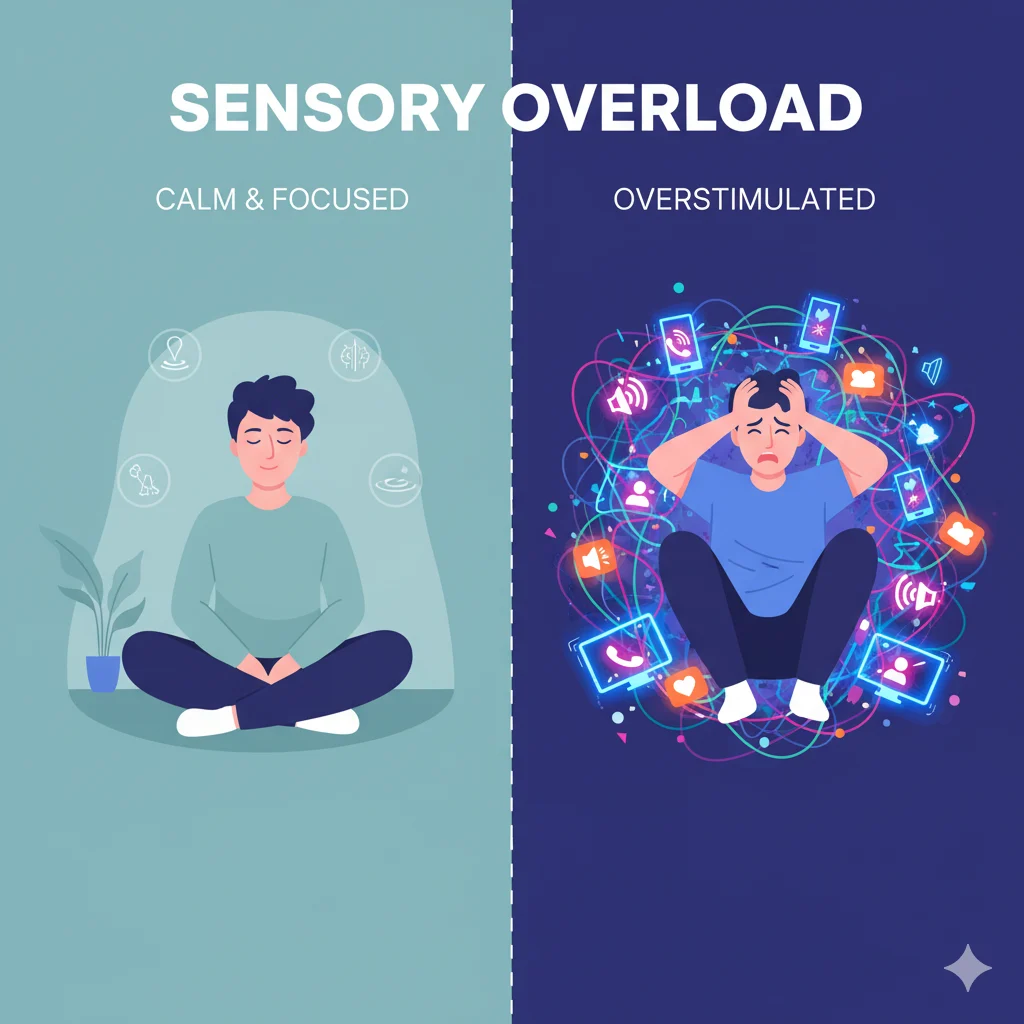
🔊 Common Signs of Being Overstimulated
Everyone reacts differently, but here are the most common signs:
| Category | Signs of Overstimulation |
|---|---|
| Physical | Headache, tired eyes, faster heartbeat, sweating, trouble sleeping |
| Emotional | Irritability, anxiety, frustration, sudden mood changes |
| Mental | Trouble focusing, forgetfulness, racing thoughts |
| Behavioral | Wanting to escape a crowd, turning off lights, avoiding noise |
If you often feel like your body wants to “shut down” or “run away” from everything — that’s your brain saying it’s overstimulated.
📱 Real-Life Examples
| Situation | Possible Overstimulation Source | Feeling |
|---|---|---|
| Being in a crowded mall | Bright lights, noise, movement | Headache, tiredness |
| Scrolling TikTok for hours | Fast videos, sounds, colors | Brain fatigue |
| Watching loud action movies | Sudden lights and sounds | Restlessness |
| Busy classroom | Noise and multitasking | Overload and anxiety |
Even good things — like excitement at a concert or amusement park — can cause overstimulation if there’s too much going on at once.
🧠 What Happens in the Brain When You’re Overstimulated
Your brain is built to take in limited sensory information at a time.
When there’s too much input — sounds, light, movement, emotions — your nervous system becomes overloaded.
Here’s what happens step-by-step:
- The senses (eyes, ears, skin) send too many signals.
- The brain can’t process them all quickly.
- The body enters “fight, flight, or freeze” mode.
- You start to feel irritated, anxious, or exhausted.
That’s why overstimulation can feel like you want to escape, sleep, or cry — your body is trying to protect you.
🧩 Overstimulated vs Overwhelmed
Although they sound similar, they’re not exactly the same.
| Term | Meaning | Example |
|---|---|---|
| Overstimulated | Too much sensory input (noise, light, etc.) | Bright concert makes you dizzy |
| Overwhelmed | Too much emotional or mental pressure | Too much homework or responsibility |
➡️ You can be overstimulated by your environment,
➡️ and overwhelmed by your thoughts —
but sometimes both happen at the same time.
🧒 Overstimulation in Kids
Children are especially sensitive to sensory input.
They might get overstimulated by:
- Loud birthday parties 🎉
- Too much screen time 📱
- Bright lights or new places 🌈
Signs in kids include:
- Crying suddenly
- Covering ears or eyes
- Running away from noise
- Needing quiet time alone
Parents and teachers often use “calm-down corners” or sensory breaks to help kids regulate their feelings.
🧑💻 Overstimulation in Adults
Adults also experience overstimulation — but often ignore it.
| Cause | How It Affects Adults |
|---|---|
| Too much screen time | Mental fatigue, eye strain |
| Work pressure | Tension, irritability |
| Social media overload | Comparison stress, anxiety |
| Multitasking | Short attention span, burnout |
If you’ve ever felt like you “can’t think straight” after hours on your phone or in meetings — that’s mental overstimulation.
🧭 How to Know If You’re Overstimulated
You might be overstimulated if you:
- Feel restless but tired
- Can’t focus or make simple decisions
- Crave silence or alone time
- Feel more emotional than usual
A simple test:
If you suddenly want to put your phone away, lower the lights, or leave a loud room — you’re likely overstimulated.
Your body is smarter than you think — it gives early signals to take a break.
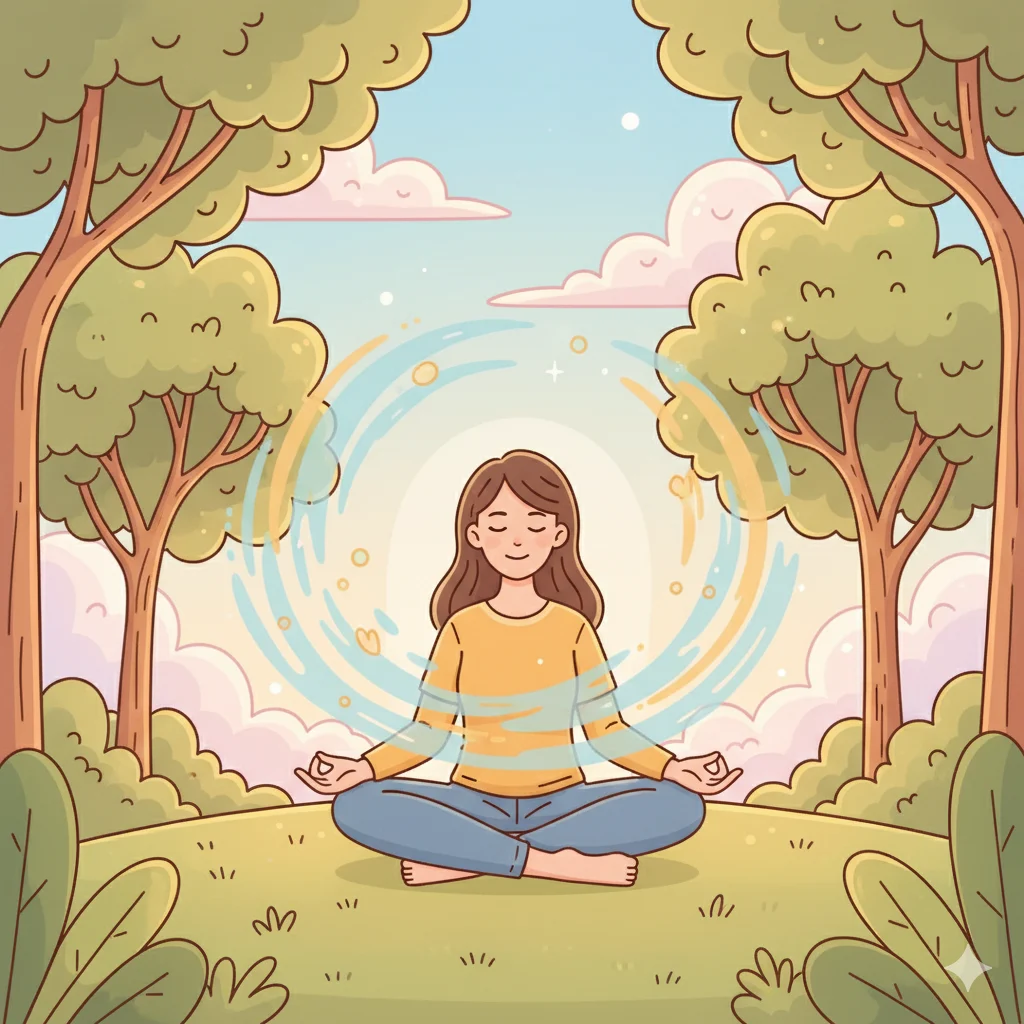
🌿 How to Calm Down When You’re Overstimulated
Here are simple, science-backed ways to reset your senses:
- Take a sensory break.
Go somewhere quiet — a room, a park, or just close your eyes for a minute. - Deep breathing.
Inhale through your nose for 4 seconds, exhale for 6 seconds — it relaxes your nervous system. - Limit screen time.
Try the “20-20-20 rule”: every 20 minutes, look away for 20 seconds at something 20 feet away. - Lower lights and sounds.
Dim the lights, reduce volume, and pause music or TV. - Touch something calming.
A soft blanket, pet, or warm cup helps your senses reset. - Go outdoors.
Nature naturally calms overstimulation — even a short walk helps. - Rest or nap.
Give your brain time to process and recover.
💬 Overstimulation in Modern Life
We live in a world full of sensory overload — screens, ads, sounds, and alerts.
Studies show that people now consume 5 times more information daily than 30 years ago.
That’s why feeling overstimulated doesn’t mean something is wrong with you — it means your brain needs balance.
Practicing digital detox, mindfulness, or quiet hobbies helps prevent constant overload.
🔬 Psychological and Medical Perspective
Experts in psychology and neuroscience explain that overstimulation affects the amygdala (emotion center) and prefrontal cortex (focus center).
When overstimulated:
- The amygdala becomes overactive → anxiety or irritability
- The prefrontal cortex slows down → poor focus
This explains why people feel both “on edge” and “foggy” at the same time.
For those with ADHD, autism, or sensory processing issues, overstimulation can be even stronger.
🧘 Simple Everyday Tips to Avoid Overstimulation
| Habit | Benefit |
|---|---|
| 10-minute tech breaks | Prevents mental fatigue |
| Soothing background music | Reduces noise overload |
| Clean, calm workspace | Less visual clutter |
| Scheduled quiet time | Helps the brain rest |
| Physical exercise | Balances sensory system |
Small daily choices create long-term calmness.
🔁 Overstimulated vs Understimulated
Sometimes, people feel the opposite — understimulated, meaning not enough excitement or input.
| Type | Meaning | Feeling |
|---|---|---|
| Overstimulated | Too much input | Overwhelmed, anxious |
| Understimulated | Too little input | Bored, unmotivated |
Balance is key — not too much, not too little.
📖 Example Sentences with “Overstimulated”
| Context | Example Sentence |
|---|---|
| Daily life | “After the party, I felt overstimulated and needed quiet.” |
| Parenting | “The toddler was overstimulated by all the lights and sounds.” |
| Mental health | “She gets easily overstimulated in crowds.” |
| Work | “He took a break because the meeting overstimulated him.” |
💬 Synonyms and Related Words
| Word | Meaning |
|---|---|
| Overloaded | Too much to handle |
| Overwhelmed | Emotionally flooded |
| Hypersensitive | Easily affected by stimuli |
| Burned out | Mentally or emotionally exhausted |
| Distracted | Unable to focus due to too much input |
Using these related words can help express overstimulation in different contexts.
❓ FAQs
Q1: What does overstimulated mean in simple words?
A: It means your brain or senses are getting too much information at once, making you feel tired or anxious.
Q2: Can kids get overstimulated?
A: Yes! Especially in noisy, busy, or bright environments like parties or malls.
Q3: What’s the difference between overstimulated and stressed?
A: Overstimulation comes from too much sensory input; stress comes from emotional or mental pressure.
Q4: How long does overstimulation last?
A: It depends, but resting in a quiet space or sleeping usually helps your body reset within minutes or hours.
Q5: Can phones and social media cause overstimulation?
A: Absolutely — constant notifications, scrolling, and bright screens are major modern causes.
🧩 Conclusion
Being overstimulated doesn’t mean you’re weak — it means your brain is working hard to process too much at once.
Everyone feels this way sometimes, especially in a world full of screens, sounds, and movement.
Remember:
- Take breaks.
- Listen to your body.
- Give your mind space to recharge.
When you learn to manage overstimulation, you’ll feel calmer, clearer, and more in control — ready to face your day with balance. 🌿

Oscar Wilde combined wit, beauty, and deep symbolism to reveal the spiritual contrasts of human life. His works often reflect the journey of the soul — from desire and art to truth and redemption. Wilde’s timeless reflections remind readers that beauty and wisdom are paths to understanding the divine within.